
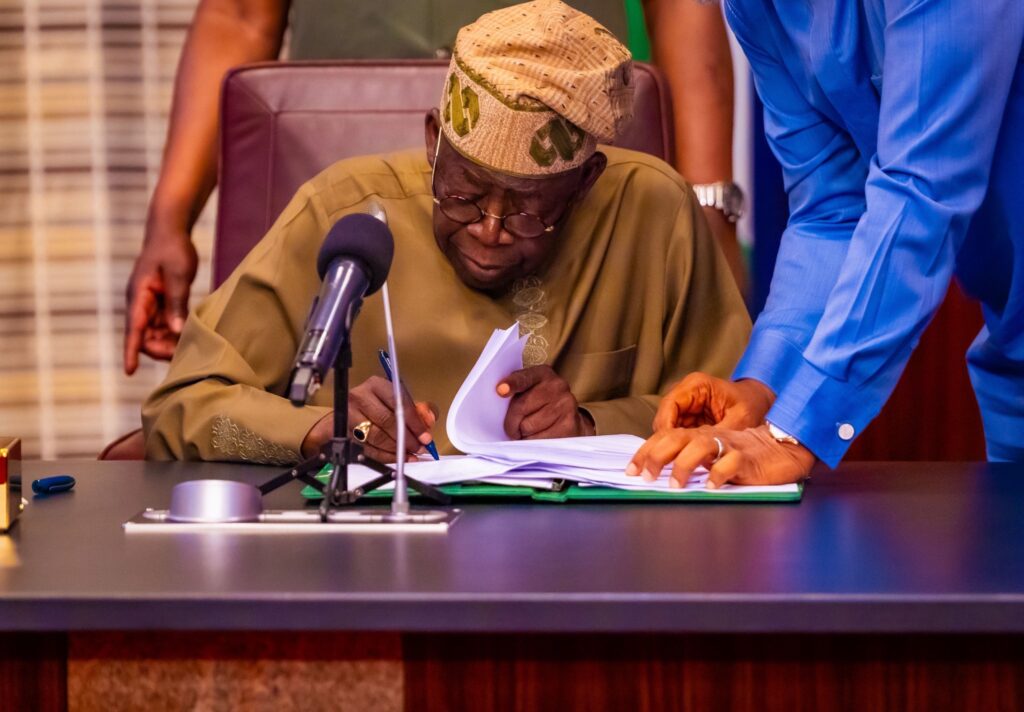
President Bola Ahmed Tinubu has approved the Carbon Market Framework for Nigeria, a major policy step expected to position the country as an active player in the global climate economy and unlock billions of dollars in green investments.
The approval was disclosed by the Director General of the National Council on Climate Change (NCCC), Mrs. Omotenioye Majekodunmi, while speaking with journalists in the United Arab Emirates on the sidelines of the Abu Dhabi Sustainability Week.
According to Mrs. Majekodunmi, the framework provides a clear regulatory and institutional structure for carbon trading in Nigeria, enabling both local and international investors to develop and finance climate-friendly projects while earning carbon credits.
She described the development as a strong signal that Nigeria is now fully open for climate-related business.
“With the final approvals in place, Nigeria is officially ready to do business. We are now positioned to begin seeing real returns. The carbon market alone is valued at over $3.8 billion in potential investments annually,” she said.
The Carbon Market Framework operates under the National Council on Climate Change, an agency established by the Climate Change Act of 2021 and domiciled in the Presidency. Under the Act, the President serves as Chairman of the Council, while the Vice President serves as Vice Chairman.
Mrs. Majekodunmi noted that the approval reflects President Tinubu’s commitment to making climate action a core pillar of his Renewed Hope Agenda.
She also revealed that Nigeria has already recorded significant interest in carbon-related projects. Since initial approvals were granted in October, the Council has received between 3,000 and 4,000 applications.
The carbon market, she said, presents opportunities across multiple sectors, including renewable energy, clean cooking, reforestation, climate-smart agriculture, and sustainable infrastructure.
Mrs. Majekodunmi further explained that Nigeria’s participation at the Abu Dhabi Sustainability Week forms part of broader efforts to deepen international partnerships, particularly with the United Arab Emirates.
“We see a lot of potential for collaboration in renewable energy, sustainable finance, climate technology, and carbon markets. As such, the Abu Dhabi Sustainability Week provides the right platform to deepen this relationship and deliver real impact,” she said.
She added that technology transfer, innovation, and local capacity development remain key priorities, with plans underway to strengthen Nigeria’s capabilities in clean energy systems, agriculture, and climate-resilient infrastructure.