
24 July, 2026
The AAGP Intergovernmental Agreement: How Far Does it Take the Project?
The signing of the Intergovernmental Agreement (IGA) for the African Atlantic Gas Pipeline (AAGP) by participating ECOWAS Member States on Sunday 20th of July 2026 at Freetown, Sierra Leone pending a similar ceremony at which Kingdom of Morocco and the Islamic Nation of Mauritania are set to sign, is not just another diplomatic step. For a project that has spent years moving from political engagement to regional consultations, it is at a point at which the initiative begins to look legally and commercially real.
The challenge has never been engineering alone. For a pipeline of this scale spanning thousands of kilometres, crossing multiple sovereign jurisdictions and requiring tens of billions of dollars in investment, the question has also been, whether the participating States could establish a sufficiently stable legal and governance framework strong enough to give sponsors, lenders and investors comfort that the project can survive political cycles and regulatory change.
The IGA does not answer every commercial or implementation question, but it does answer one of the most important threshold questions: whether there is now a binding State-level framework around which the project can be organised.
What is an Intergovernmental Agreement (IGA)?
Put simply, an Intergovernmental Agreement is a treaty between sovereign States. In the context of a cross-border infrastructure project, it sets the legal and institutional basis on which the project will be developed, financed, constructed and operated.
This matters because an IGA is different from a Memorandum of Understanding. An MoU usually records political or commercial intent. An IGA goes further: it creates legally binding obligations between participating governments. It sets out common rules and principles on issues such as governance, regulatory cooperation, fiscal treatment, transit arrangements, dispute resolution, environmental standards and the respective rights and obligations of the participating States.
This distinction is particularly important for cross-border infrastructure.
This distinction is not merely technical. It is central to whether a project of this nature can move from announcement to execution.
A pipeline that traverses several jurisdictions cannot possibly be governed by the domestic law or policy preference of one. Investors and lenders require assurances that the infrastructure will not be at risk, at every border, to inconsistent regulations, unpredictable fiscal treatment or competing national priorities. The IGA is the legal architecture designed to mitigate those risks and create a more predictable investment environment.
WHY NOW?
The project is the child of a 2016 bilateral initiative between the Head of State of the Federal Republic of Nigeria, President Muhammudu Buhari and King Mohammed VI of the Kingdom of Morocco. Since then, a series of steps culminating in feasibility studies, technical assessments, environmental and social impact studies and extensive stakeholder consultations with coastal States have gradually reshaped the initial concept into a regional energy corridor. The need for an IGA existed from the moment the project involved infrastructure crossing sovereign borders.
The change in nomenclature from the Nigeria–Morocco Gas Pipeline to the African Atlantic Gas Pipeline was significant, as the project no longer simply connects two countries. Linking primarily Nigerian gas resources to several coastal economies along the right of way, is now set to deepen regional integration.
The signing of the IGA moves the project from political signaling and technical preparation into a more structured legal phase, where commercial development can be matched with State obligations.
The timing is also significant. Energy security, gas supply diversification and regional infrastructure are again high on the international agenda. By signing the IGA, the thirst for alternative fuel resources by the economies of the global north is aroused, their technical and financial value add is stimulated, thus, improving bankability of project finance and other infrastructure support which a large project requires, to guarantee build and profitability.
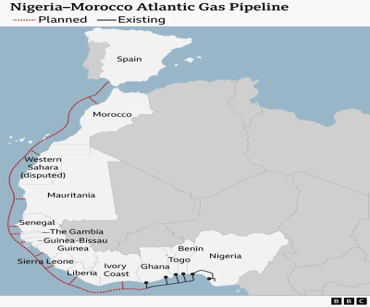
Image Source: The BBC
IMPORTANCE OF THE IGA TO THE AAGP
As a primary factor, the IGA reduces political and regulatory uncertainty.
Large infrastructure projects often struggle not because of engineering challenges, but because investors are unable to assess long-term political risks. Governments change. Policies change. Fiscal regimes change. Regulatory priorities evolve.
Though the sovereignty of member states makes it impossible to totally eliminate these risks, it makes them more manageable, by committing the participating States to a common framework before the project moves into significant and cost heavy stages of financing and implementation.
Projects of this magnitude are financed over long horizons. Development finance institutions, export credit agencies and commercial lenders will want to understand whether the legal architecture of the project is stable enough to support debt, equity and other commitments over its lifecycle. A binding intergovernmental framework is therefore not merely desirable. It is often a prerequisite for kick-starting cross-border projects.
There is no better illustration of the importance of an IGA to projects like this than the state at which a similar project this time for power, is currently stalled. Informed sources state that the Sila Atlantik, an underwater power cable project between the Republic of Germany and the Kingdom of Morocco is currently in suspension for a number of reasons principal among which is the unwillingness of parties to position an IGA.
Up next is the need to ensure harmonised approaches to permitting, environmental regulation, customs procedures, land access, security, taxation and operational oversight. Without such coordination, delays and inconsistencies can significantly undermine project delivery.
The IGA establishes the platform through which these issues can be managed collectively rather than individually.
For investors, the signature communicates that the project has political support across participating States.
For host governments, it demonstrates a shared commitment to regional cooperation.
To development partners, it suggests that the institutional framework needed to support investment is in place and thereby in a position, to support and sustain it.
What Happens Next?
The IGA is a major achievement, but it is by no means the finish line. The hard work now shifts to implementation.
The next phase is likely to focus on:
- Finalisation and execution of Host Government Agreements with participating States;
- Establishment and operationalisation of the project company and governance arrangements;
- Structuring of project financing;
- Negotiation of commercial agreements, including transportation and operational arrangements;
- Engineering, Procurement and Construction (EPC) contracting;
- Progress towards a Final Investment Decision (FID).
These steps will test whether the legal consensus expressed in the IGA can be translated into bankable contracts, credible financing and a workable delivery structure.
The IGA also sets up a contractual nexus, to which both sides may look, for advancing their objectives.
The Road Ahead
The signing of the IGA marks a significant milestone, but its real value will be measured in what follows. The agreement creates the legal base; the next task is to convert that base into project documents, financing commitments, procurement decisions and ultimately construction activity.
That will require substantial capital mobilisation from development finance institutions, export credit agencies, commercial lenders and private investors. It will also require sustained cooperation among participating States on regulation, security, environmental obligations and long-term market development.
The IGA does not guarantee delivery. What it does is give the AAGP a stronger legal and institutional footing than it had before. For a project of this ambition, that is a meaningful step forward.